Quick reference
| Waterfall | Height | Location | Permanent? |
|---|---|---|---|
| Lady Bowen Falls | 162 m | Milford Sound (near terminal) | Yes |
| Stirling Falls | 151 m | Milford Sound (mid-fiord) | Yes |
| Sutherland Falls | 580 m | Arthur Valley, Milford Track | Yes |
| Browne Falls | 619–836 m (disputed) | Doubtful Sound, Hall Arm | Yes (reduced in dry) |
| Helena Falls | ~200–220 m | Doubtful Sound, Deep Cove | Yes |
| Humboldt Falls | 275 m | Hollyford Valley, Milford Road | Yes |
Milford Sound waterfalls
Lady Bowen Falls (Hineteawa) — 162 m
The tallest permanent waterfall in Milford Sound, and taller than Niagara. Fed by the 9 km Bowen River, it supplies the Milford township with both drinking water and hydro-electricity. It's named after Diamantina Bowen, wife of New Zealand's fifth Governor (who visited in 1871); the Māori name Hineteawa means "girl of the river." Sitting closest to the terminal, it's usually the first major waterfall you see on a cruise.
Stirling Falls (Waimanu Falls) — 151 m
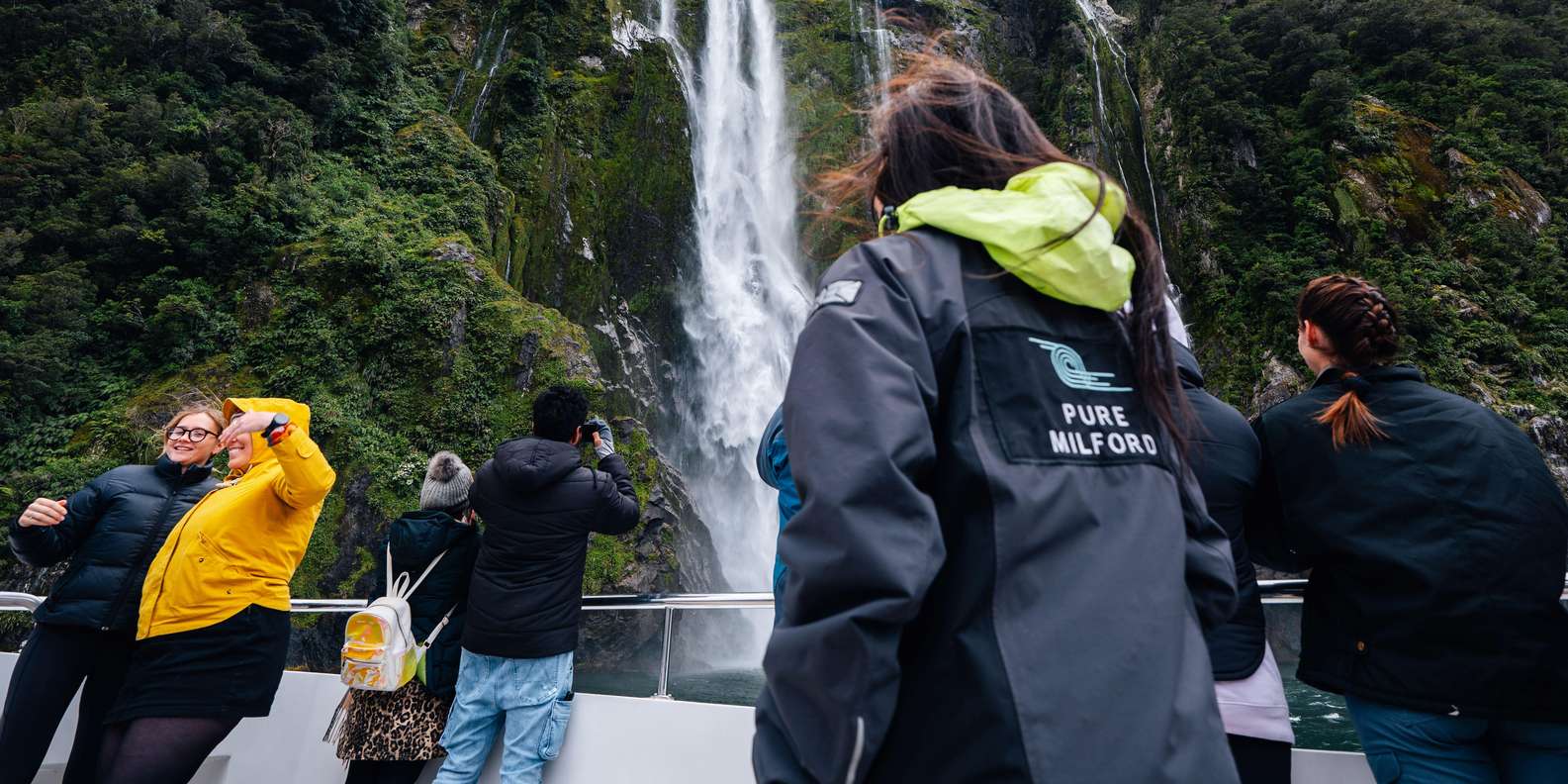
The second-tallest permanent fall in Milford Sound, fed by glaciers and snowmelt from a hanging valley between Elephant Mountain and Lion Mountain. It's named after Frederick Stirling, a Royal Navy captain of the 1870s; the Māori name Waimanu means "water of birds." This is the home of the famous "glacial facial" — cruise boats nose their bow directly under the cascade, soaking passengers on the open deck in cold glacial spray of around 8–12°C. You can't swim beneath it (unsafe and not permitted), and it even featured in X-Men Origins: Wolverine (2009).
Queenstown: Milford Sound Coach & Cruise Full-Day Trip
The classic way to experience Stirling and Bowen Falls — a 2-hour cruise that noses right under the spray, plus the scenic alpine drive, with lunch included and free cancellation up to 24 hours before. Check live dates and prices below.
Other notable Milford falls
- Fairy Falls: near-permanent; some operators nose under it too.
- Bridal Veil Falls: a semi-permanent white veil, most impressive after rain.
- The Four Sisters: four parallel cascades that appear after rain, often with rainbows.
- Palisade Falls: a ~80 m, two-drop fall near Stirling Falls.
The rain waterfall phenomenon
After heavy rain, hundreds of temporary waterfalls burst out across the cliff faces — a figure of up to ~2,000 cascades is sometimes quoted (a vivid tourism estimate rather than a precise count). They appear within minutes and vanish just as quickly once the sun returns, because the impermeable granite lets rainfall run straight off rather than soak in. It's exactly why a rainy Milford day is so often described as the most spectacular. Mean annual rainfall is around 6,412 mm over roughly 182 rain days; the wettest months are December and January (peak tourist season), and the driest is July.
Milford Road waterfalls (SH94)
Some of Fiordland's best falls are on the drive in, not on the water.
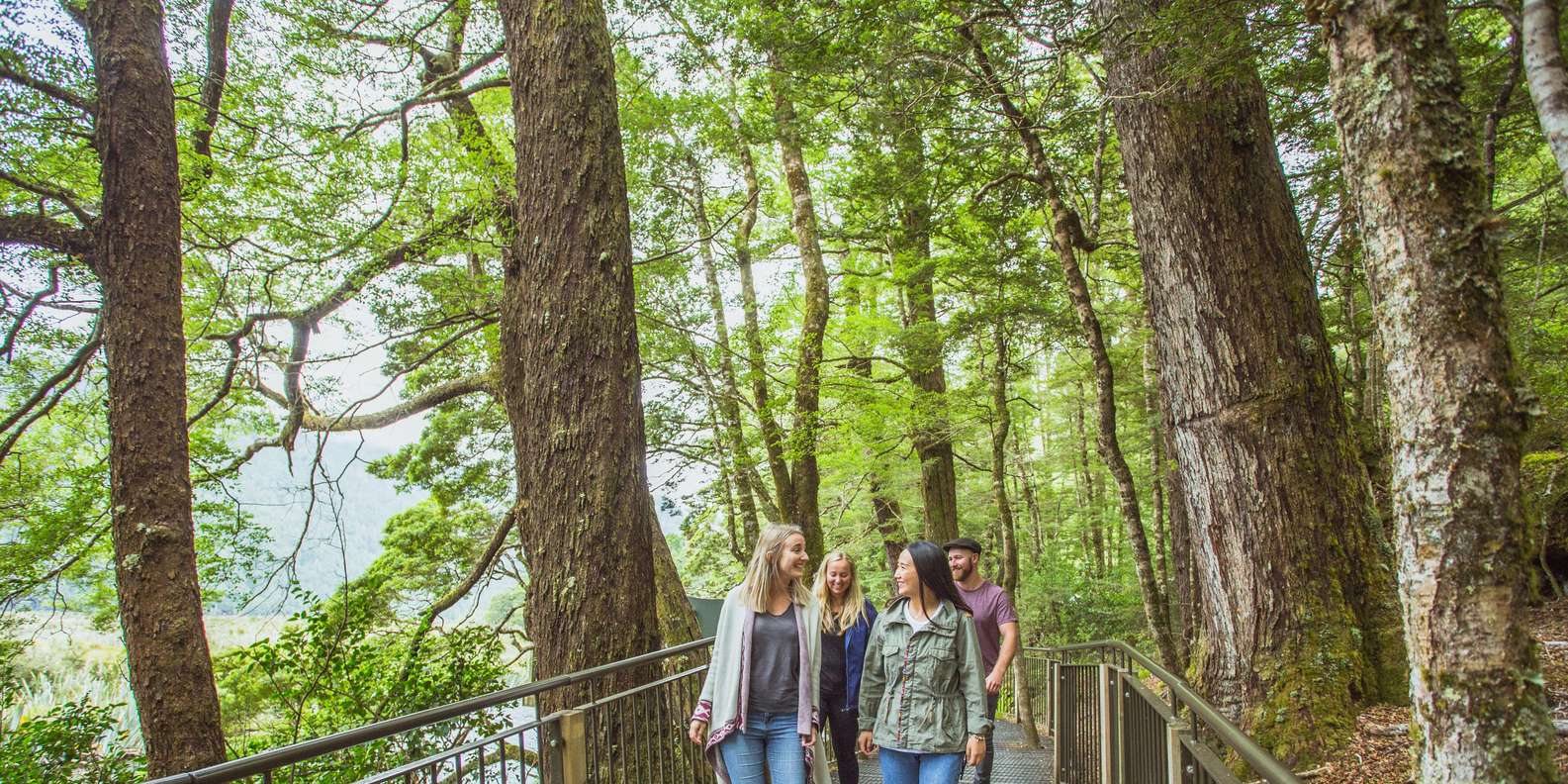
- The Chasm (~109 km from Te Anau): a Cleddau River gorge of powerful falls and sculpted potholes, reached by a short 400 m forest walk. Note: the viewing bridges were washed away in a February 2020 storm and DOC reinstatement is ongoing — check the DOC website before relying on the full loop being open.
- Humboldt Falls (~17 km down Hollyford Road): 275 m in three leaps, reached by a steep but well-graded 30-minute return walk to a lookout. Best after rain, flows year-round.
- Christie Falls, Marian Falls and the Cleddau "Hundred Falls": roadside and short-track falls, plus a viewpoint just after the Homer Tunnel where hundreds of temporary falls pour down the valley walls after rain.
Sutherland Falls — 580 m
New Zealand's tallest free-leaping waterfall drops in three cascades — an upper leap of 229 m, a middle of 248 m and a lower of 103 m — fed by Lake Quill, a high cirque lake at around 1,000 m that overflows down a sheer cliff into the Arthur Valley. European explorer Donald Sutherland first saw it in 1880 while searching for a route between Milford Sound and Lake Wakatipu; the 580 m figure was confirmed by an 1888 expedition.
How to see it: the classic way is a side trip on Day 3 of the Milford Track (~90 minutes return from Quintin Lodge) — a DOC Great Walk with bookings that open each year at 9:30am NZST on the second Wednesday of May. The only same-day alternative is a scenic flight from Milford Sound or Te Anau up the Arthur Valley; some include a landing near Lake Quill. Sutherland Falls is not visible from the Milford Sound cruise — it lies inland, not on the fiord.
From Queenstown: Milford Sound Full-Day Trip by Plane & Boat
Fly over the Southern Alps, the Arthur Valley and Fiordland's towering inland waterfalls, then cruise the fiord — the fastest way to take in the falls you can't see from the water. Highly rated and ideal if you're short on days.
Doubtful Sound waterfalls
Browne Falls — 619 m or 836 m (disputed)
The World Waterfall Database ranks Browne Falls as New Zealand's highest (836 m / 2,744 ft) and the 10th-highest globally; the shorter 619 m figure reflects a single section, while 836 m is the total drop from Lake Browne to the fiord. It's named after aerial photographer Victor Carlyle Browne, who spotted it in the 1940s. Because it tumbles down the mountainside as a long, multi-step cascade rather than a single free fall, some consider it a cascade rather than a true waterfall — which is what keeps its "tallest" claim in dispute. It's visible from Doubtful Sound cruises near Hall Arm, most dramatic in spring snowmelt and after rain.
Helena Falls — ~200–220 m
A permanent fall near Deep Cove at the innermost head of Doubtful Sound, visible from cruises and the dock and accessible via the Helena Falls Track from the Deep Cove road end. Deep Cove receives around 5,290 mm of rain a year, so after heavy downpours the steep fiord walls fill with temporary falls — Milford's spectacle in a far quieter setting.
From Queenstown: Doubtful Sound Wilderness Day Trip
Cruise New Zealand's deepest fiord past Browne and Helena Falls, with the boat-coach-boat journey from Manapouri and far fewer people than Milford. Free cancellation up to 24 hours before. Check live dates and prices below.
Why Fiordland has so many waterfalls
During the Ice Ages, glaciers carved U-shaped valleys into hard crystalline rock — gneiss, granite and diorite. When the ice retreated and the sea flooded the main valleys, smaller tributary streams were left "hanging" high above the fiord, and they now plunge as waterfalls. The impermeable rock means rainfall runs straight off rather than soaking in, and with annual rainfall exceeding 6 m across much of Fiordland, the result is one of the world's most waterfall-rich landscapes.
Planning guide: when and where to see them
Best time for waterfalls
- Permanent falls (Bowen, Stirling): year-round, with the biggest flow after rain and during spring snowmelt.
- Temporary rain falls: any time it rains heavily; December–January are the wettest months.
- Sutherland Falls: best spring–autumn; Milford Track access is limited to the Nov–Apr Great Walks season.
- Browne Falls: biggest in spring snowmelt, reduced to a trickle in extended dry summer spells.
Best vantage points
- Cruise boat: the only way to nose under Stirling Falls — and the best all-round waterfall viewing.
- Kayak: water-level access to Stirling and Fairy Falls.
- Foreshore Walk (Milford): a free 400 m loop with partial views of Bowen Falls.
- Walking tracks: The Chasm (when open), Humboldt Falls and the Milford Track falls (Sutherland, Giant Gate, Mackay).
- Aerial: Sutherland Falls, Browne Falls and the Cleddau Valley falls — otherwise impossible to see.
Rain isn't a problem here — it's the main event. Local operators agree the fiords are arguably more spectacular when wet, and the rain also dramatically reduces the sandflies. Planning the cruise itself? See our Milford Sound from Queenstown day-trip guide, compare every boat in our Milford Sound tours comparison, or read the full Doubtful Sound cruise guide.
Heights vary by source: Stirling Falls is most often cited at 151 m (146 m and 155 m also appear), Browne Falls at 619–836 m, and Milford's rainfall at 6,412 mm (Wikipedia/NIWA) to 6,813 mm (operator sites). Confirm DOC track status before travelling.